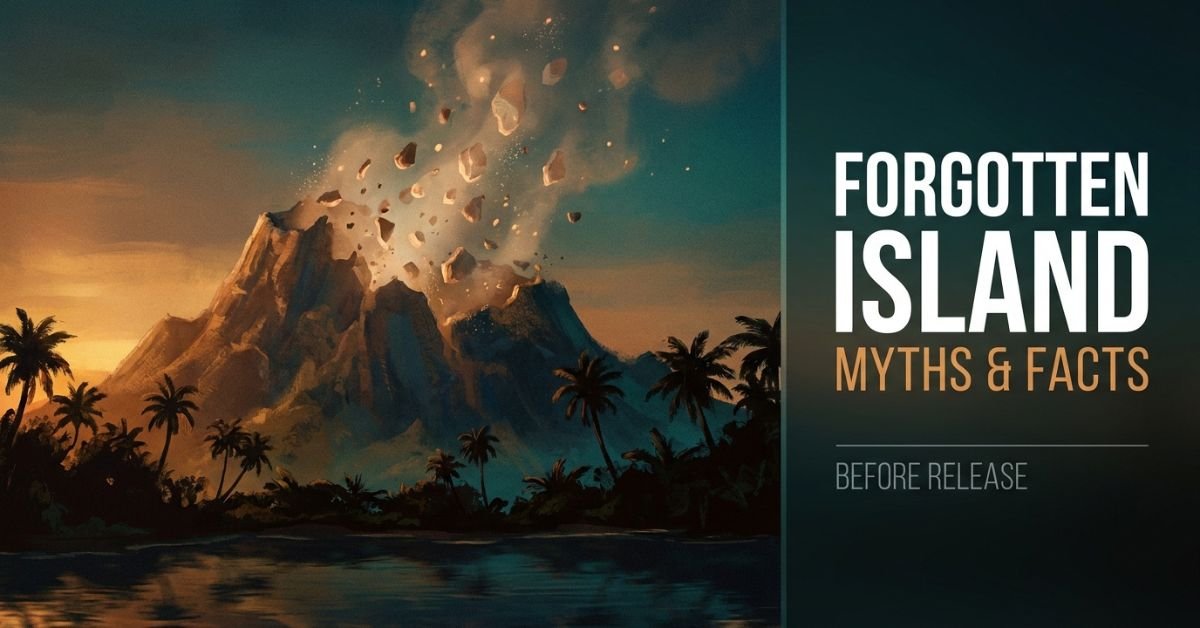
Forgotten Island Movie: The Myths and Facts Before Release Day
Fifty features. That is the number DreamWorks Animation reaches with this release, and the studio chose a milestone slot for something it has not attempted often lately a story with no franchise behind it, no book to adapt, and no returning characters to lean on.
The result is a film surrounded by more assumption than information. Trailers travel fast across borders. Context does not. So before anyone books a seat anywhere in the world, it is worth separating what this film actually is from what the internet has decided it is.
Quick Answer: Forgotten Island is DreamWorks Animation’s fiftieth feature an original animated fantasy adventure set in the Philippines of the 1990s. Written and directed by Joel Crawford and Januel Mercado, it follows two lifelong friends trapped on an island that slowly consumes memory. It reaches Philippine cinemas on 23 September 2026 and other major markets from 25 September.
The Basics In One Card
| Detail | What Is Confirmed |
|---|---|
| Studio | DreamWorks Animation, released through Universal Pictures |
| Directed and written by | Joel Crawford and Januel Mercado |
| Produced by | Mark Swift |
| Release | Philippines 23 September 2026; wider release from 25 September 2026 |
| Runtime | Listed at roughly 108 minutes |
| Music | Score by Nathan Matthew David |
Local dates shift by territory, as they always do. If you are reading this outside North America or Southeast Asia, treat late September as the window and confirm with your own cinema chain, because studios stagger animated releases around school holidays in each region.
The story itself compresses neatly. Two girls grow up inseparable in the 1990s Philippines. After finishing school, one is being steered toward university abroad while the other cannot accept the separation. Before the argument resolves, a portal takes them both to Nakali, an island where the longer you remain, the more of your own history quietly disappears.
It Is Just Another Sunny Island Adventure
Put the word island in an animated title and most viewers picture beaches, a spirited musical number, and a lesson about finding yourself. This premise runs the opposite way.
Nakali is not a destination the characters are lucky to reach. It erodes them. The longer the two friends stay, the more of their shared past thins out, and the exit they are hunting for demands the friendship itself as the toll. That single design choice reshapes everything around it. Two people growing apart after school is an ordinary sadness that almost every adult recognises. Turning that drift into a literal, ticking mechanism inside a fantasy adventure is a far sharper idea than the marketing shorthand suggests.
There is a reason it lands with that much specificity. The two directors have worked alongside each other at the same studio since the early 2010s, and the story grew directly out of their own long friendship rather than a development slate.
It Is A Sequel, Spin-Off Or Franchise Extension
This assumption is understandable. Large animation studios have leaned heavily on continuations for years, so audiences reasonably expect a new title to connect to something.
Nothing here connects. Forgotten Island stands alone, with no earlier film, no source novel, and no established characters. For the director who has previously handled two well-received continuations at the studio, it is the first project without that safety net. For his co-director, it is a debut in the chair after years working as a story lead and co-director.
That has consequences worth understanding as a viewer. A sequel arrives with an audience already assembled. An original arrives needing to explain itself in a trailer, which is precisely why so much of the promotional material has been built around the emotional premise rather than the fantasy setting.
The Footage Looks Like Anime, So It Must Be Anime
This is the most interesting technical decision in the film and the one most often misread.
The main body of the film is contemporary CG animation, textured and stylised rather than photoreal. At specific points, though, the picture drops into flat, hand-drawn 2D. Those passages are used for memory sequences, and the drawing style shifts according to whose memory is playing — echoing the action shows, fighting games and magical-girl series that shaped a generation of nineties childhoods across Asia and beyond.
The choice carries weight beyond aesthetics. Those 2D sequences were produced by an animation studio based in Manila, referencing decades in which Philippine studios did enormous volumes of drawing work on series commissioned elsewhere. Artists in that country spent years animating other people’s stories for foreign screens. Here, that labour history is folded into the film’s own visual grammar instead of being kept off-screen.
For viewers anywhere, the practical effect is simple: the film changes texture mid-scene, on purpose, and those switches are meant to feel like a jolt.
It Is A Children’s Film, So The Monster Is Harmless
The central threat is a manananggal, positioned as the most feared figure on the island and voiced by one of the most recognisable performers in the cast. Supporting creatures include a tiyanak and a batibat, alongside a good-natured were-dog who joins the leads.
These are not invented cartoon villains. In Philippine folklore they are the stories older relatives use to keep children indoors after dark, and the film does not appear to have sanded them down into plush toys. Early audience reports from unfinished screenings describe the villain’s entrance genuinely upsetting some very young viewers.
Practical guidance, stated plainly rather than guessed at: classification differs by country, and the certificate assigned in one market tells you little about another. Check the rating displayed by your local cinema or classification board before booking for small children, and watch a trailer with them first if you are unsure. Older children and teenagers are almost certainly the sweet spot here.
It Only Really Matters To Filipino Audiences
The last decade has settled this argument fairly conclusively. Animated films rooted deeply in one culture have repeatedly crossed borders better than films engineered to offend no one, because specificity produces texture and texture produces memorability.
Forgotten Island has been assembled on that logic rather than in spite of it. The voice cast pairs internationally known performers with Filipino actors and comedians. The filmmakers have consistently described the culture as the foundation of the project rather than a coat of paint, and have made a point of crediting the Filipino artists whose work shaped it.
The music may be the strongest crossover instrument of all. The soundtrack brings together Filipino pop groups, veteran vocalists and contemporary hip-hop artists alongside the two leads, and one of the songs was performed live during a major international convention appearance ahead of release. Pop fandoms are borderless and highly organised. A film with an active music fanbase attached to its release is not aiming at one country.
If you have no connection to Philippine culture at all, you are in the same position an international viewer occupies with any well-made regional story: you will not catch every reference, and the film is built so that this does not matter.
A Big-Studio Original Is Automatically A Hit
Here honesty serves readers better than enthusiasm.
Pre-release forecasts have pointed toward an opening in the region of twenty to thirty million dollars in North America, which is the market most commonly used as a benchmark. That is a respectable but unspectacular projection, and the wider record for non-franchise animated originals from this studio explains why forecasters hedge. Comparable titles have opened anywhere from around five million to above fifty million.
| Reference Point | Approximate Opening Weekend |
|---|---|
| Strongest recent original | Around $50M |
| Recent book-adapted successes | Around $35M–$36M |
| Mid-range originals | Around $20M–$24M |
| Weakest recent original | Around $5.5M |
Two structural factors cut in opposite directions. In its favour, it was scheduled into a weekend with little direct competition for family audiences. Against it, it must build recognition from a standing start, without a bestselling book or a familiar character to shortcut awareness.
For readers outside North America, the more meaningful number will be the international total, and that will depend heavily on how the Southeast Asian rollout performs in the days before the wider opening.
There Is Nothing Here That Needs A Cinema Screen
Unfinished versions of the film have already screened twice in front of very different rooms — an exhibition industry showcase earlier in the year, and a major international animation festival in early summer. The festival response was strong enough to produce a lengthy standing ovation, which is not a courtesy that audience extends automatically. Festival crowds at that level are largely animators, and they are hard to impress with a logo.
Treat that as encouraging rather than conclusive. Work-in-progress cuts change. Ovations at festivals do not always predict how a film plays to a family audience on a wet Sunday afternoon.
What is fair to say is that the film’s specific pleasures are format-sensitive. Animation that switches drawing styles mid-sequence, creature design built on unfamiliar folklore, and a soundtrack recorded with live vocal performances all lose something on a phone screen in a noisy room.
Quick-Scan Myth And Fact Table
| The Myth | The Fact |
|---|---|
| Standard tropical adventure | The island erodes memory; escape costs the friendship |
| A sequel or franchise entry | Fully original; a directing debut for one of the pair |
| It is anime | CG film with deliberate hand-drawn 2D memory sequences |
| The monster is decorative | Creatures drawn from genuinely frightening folklore |
| Only for one national audience | Built for crossover, with a globally targeted soundtrack |
| Guaranteed blockbuster | Forecasts are mid-range, not exceptional |
| Wait for streaming | Visual and sound design reward a proper screen |
Key Takeaways
- The film opens in the Philippines on 23 September 2026, with wider release from 25 September; local dates vary.
- It is an original story, not part of any existing franchise, and the studio’s fiftieth animated feature.
- The setting is the Philippines in the 1990s, and the mythology is drawn from that tradition.
- The animation shifts between CG and hand-drawn 2D, with the 2D work produced in Manila.
- Check your local certificate before booking for young children, since ratings differ by country.
- Commercial expectations are solid rather than spectacular, which is normal for an original.
Who Should Book Opening Night, And Who Should Wait
Book early if you follow animation as a craft and want to see a mainstream studio experimenting with mixed styles; if you have any personal connection to Philippine culture and want to watch it with an audience rather than alone; if you follow any of the musicians on the soundtrack; or if you enjoyed the same director’s previous work enough to trust the instincts on display there.
Wait if your children are young enough that a sincerely scary folklore figure would end the evening badly — check the rating and preview a trailer first. Wait also if you prefer reviews of the finished film before committing, which is entirely reasonable, since everything circulating so far comes from marketing and unfinished screenings.
And if you are somewhere the film opens weeks later than the headline date, that delay is normal distribution practice, not a sign of anything about quality.
FAQ
Q1. When is the Forgotten Island movie released?
It opens in the Philippines on 23 September 2026 and in wider markets from 25 September 2026. Individual countries may receive it slightly later, so confirm locally.
Q2. What is the Forgotten Island movie about?
Two lifelong friends in the 1990s Philippines are pulled through a portal onto Nakali, a fantastical island where memories fade the longer a person stays, and must escape before they forget each other.
Q3. Is Forgotten Island part of a series?
No. It is a standalone original film with no prior instalments and no source book.
Q4. Is the film suitable for young children?
It is a family film, but the folklore creatures are designed to be genuinely frightening. Classification varies by country, so check the certificate where you live before booking for under-eights.
Q5. Why does the animation style change during the film?
The 2D sequences represent memories, and the drawing style shifts depending on which character is remembering, referencing the animated shows of the era in which the story is set.